The study of chemical reactions, isomerizations and physical behavior that may occur under the influence of visible and/or ultraviolet light is called Photochemistry.
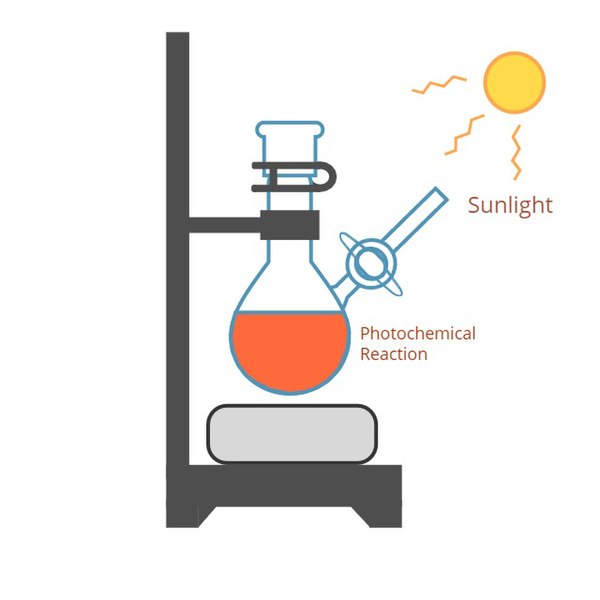
The Basic Laws of Photochemistry
The First Law of Photochemistry states that light must be absorbed for photochemistry to occur. This is a simple concept, but it is the basis for performing photochemical and photobiological experiments correctly. If light of a particular wavelength is not absorbed by a system, no photochemistry will occur, and no photobiological effects will be observed, no matter how long one irradiates with that wavelength of light.
The Second Law of Photochemistry states that for each photon of light absorbed by a chemical system, only one molecule is activated for a photochemical reaction. This law is true for ordinary light intensities, however, with high-powered lasers, two-photon reactions can occur, i.e., the molecule is raised to a higher energy state than produced by single-photon absorption.

 Site Title